
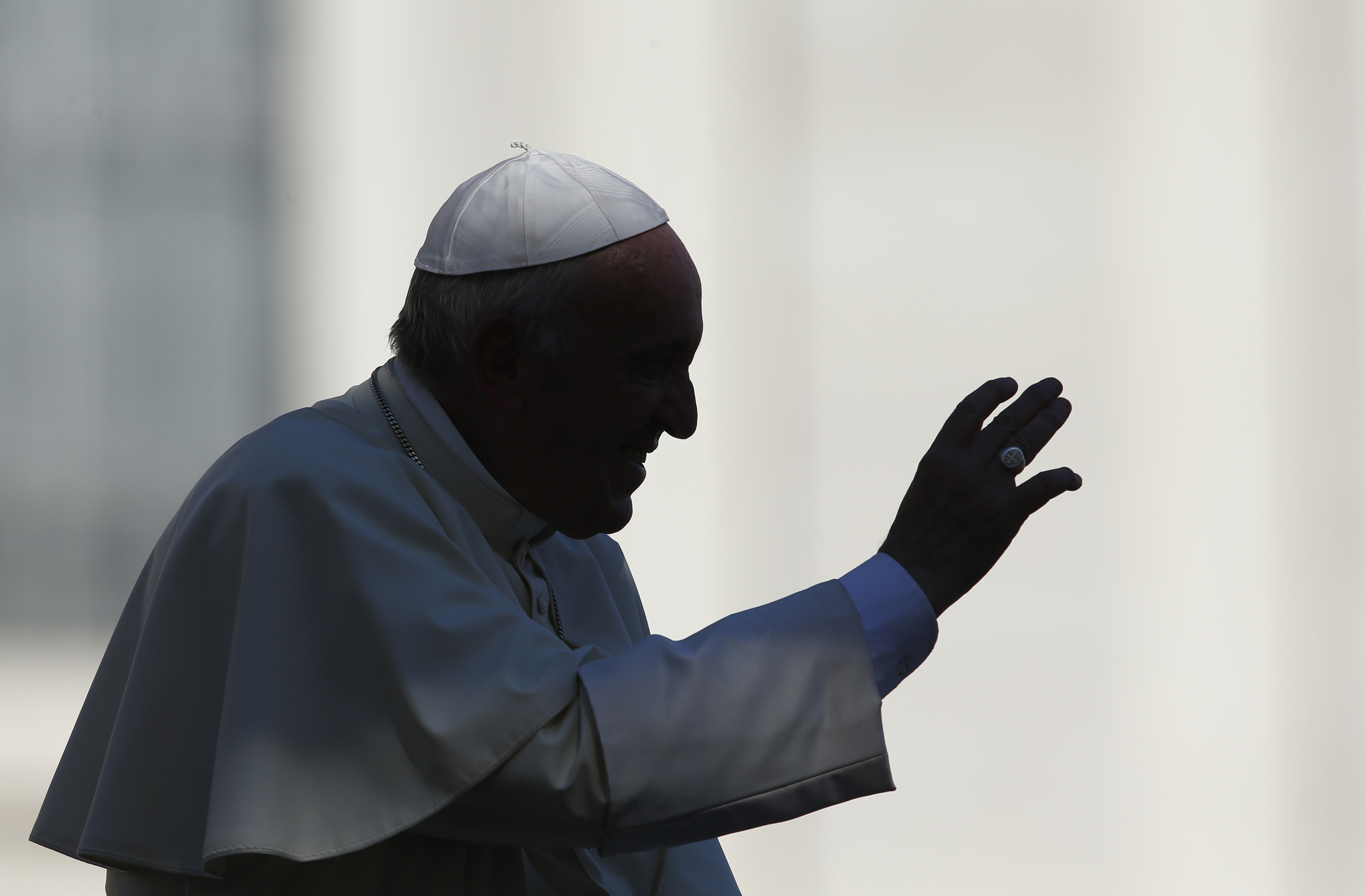
A consultant to the U.S. bishops’ Committee on Doctrine has stepped down following the publication of a serious criticism of Pope Francis in a number of Catholic media outlets on Nov. 1. In a letter addressed to Francis, Thomas Weinandy, O.F.M., Cap., complained that “a chronic confusion seems to mark your pontificate.”
He added that at times “your manner” appears “to demean the importance of Church doctrine” and that “faithful Catholics can only be disconcerted by your choice of some bishops.” Father Weinandy described those choices as “men who seem not merely open to those who hold views counter to Christian belief but who support and even defend them.”
“What scandalizes believers,” he wrote, “is not only your having appointed such men to be shepherds of the Church, but that you also seem silent in the face of their teaching and pastoral practice.” Father Weinandy’s sharp comments focused on the continuing controversy over the practical import of “Amoris Laetitia,” the apostolic exhortation issued by Pope Francis in 2016.
Father Weinandy’s letter was dated July 31, the feast of St. Ignatius Loyola, founder of the pope’s Jesuit order.
The U.S. Conference of Catholic Bishops responded quickly after the letter became public. A brief statement announcing Father Weinandy’s resignation noted that “the work of the Committee is done in support of, and in affective collegiality with, the Holy Father and the Church in the United States.” It was followed soon after by another “on the nature of dialogue within the Church today.”
The statement, signed by Cardinal Daniel N. DiNardo of Galveston-Houston, president of the U.S. Conference of Catholic Bishops, took Father Weinandy’s letter as “an opportunity to reflect on the nature of dialogue within the Church.” Cardinal DiNardo urged that in discussion of church teaching that Christian charity “be exercised by all involved” even as legitimate differences are acknowledged.
“Throughout the history of the Church, ministers, theologians and the laity all have debated and have held personal opinions on a variety of theological and pastoral issues,” Cardinal DiNardo wrote. “In more recent times, these debates have made their way into the popular press”—something he described as “expected” and “often good.”
But some of these reports, he added, “are often expressed in terms of opposition, as political—conservative vs. liberal, left vs. right, pre-Vatican II vs Vatican II. These distinctions are not always very helpful.”
He urged that in “honest and humble discussions around theological and pastoral issues…. We must always keep in mind St. Ignatius of Loyola's ‘presupposition’ to his Spiritual Exercises: ‘…that it should be presumed that every good Christian ought to be more eager to put a good interpretation on a neighbor's statement than to condemn it.’”
He added, “This presupposition should be afforded all the more to the teaching of Our Holy Father.” The cardinal described the U.S. bishops’ conference as “a collegial body of bishops working towards that goal.”
“As Pastors and Teachers of the Faith, therefore, let me assert that we always stand in strong unity with and loyalty to the Holy Father, Pope Francis,” he wrote, “who ‘is the perpetual and visible source and foundation of the unity both of the bishops and of the whole company of the faithful’ (LG, no. 23).”


 Posts
Posts


No comments:
Post a Comment